




























 Back to Related Links 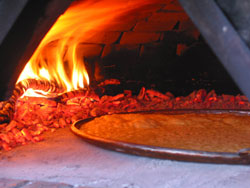 IN SEARCH OF FARINATA:
Liguria's Ancient Comfort Food from PASTA Magazine (January 2003) Every region has its comfort food, its local dish imbued with memories, tradition, and nostalgia. In Liguria, the region flanking Genoa along Italy's northwest coast, that dish is farinata. A deceptively simply street food, farinata is somewhat like a large chickpea crepe, cooked on pizza-sized copper pans in wood-burning ovens and served up steaming hot on wax paper to eat on the spot or carry home. Crisp and golden on the top, soft and moist on the inside, glistening with fragrant olive oil on the bottom, farinata is a finger-lickin' food that nourishes the soul. Bring up the subject of farinata to any native Ligurian, and chances are good that they'll wax poetic, conjuring up vivid scenes from the past. They'll tell you how as children they picked up golden slices on the way to school to keep for a midday snack, or played truant and sprawled on the sidewalk outside the farinata shop, sharing un gottu (a glass of white wine) and some piping hot slices with friends. They'll talk of farinata vendors who wound their way through the outdoor markets on bicycle, carefully balancing boxes of farinata to parcel out to housewives. They'll remember the bustling ports of yore, when farinata shops stayed open 24 hours a day to supply the hard-working fishermen and porters with sustenance. And if you're lucky, they'll invite you over for farinata, cooked in an outdoor oven behind their house, where the smell of a wood fire and chickpeas turns the fall evening into a new and perfect memory. Sadly, farinata is vanishing from the local landscape. Many of the shops that specialized in farinata have closed down over the years. "It's a hard job. The shops are disappearing because no one wants to do it anymore," says Alessandro Barone, who since age 17 has labored at Carega Andrea & C., the oldest farinata shop under the Renaissance arcades of Via Sottoripa in Genoa. Situated across the street from the ancient port, now a popular tourist destination, this tiny white-tiled storefront is one of only three remaining along this stretch. Their disappearance is further prompted by the fact that "the panifici (bread shops) now prepare it, so there's more competition," as Barone notes. Meanwhile in the countryside, the wood-burning ovens that were once so common in people's backyards have been vanishing as well, victim to the modernization bug that prompted homeowners in the sixties and seventies to tear down traces of the past while renovating. Except for a rare escapee, the outdoor ovens where once bread, pizza, foccacia, and farinata were prepared are gone. But what goes around comes around. Today the old ways are turning chic, so one now sees newly built and even prefabricated ovens cropping up, ready to revive an ancient culinary tradition. No one knows farinata's precise origins, but many of the shops along the Ligurian coast have been in operation for well over 100 years. What is known is that chickpeas have been a staple in the diet of Ligurians and other Mediterranean cultures since time immemorial. First grown in ancient Egypt and the Levant, chickpeas are a key ingredient in Middle Eastern and North African cuisine and are even mentioned in the Bible. Subsequently Italians up and down the peninsula adopted this versatile legume in various ways - in soups, stews, cold salads, and combined with pasta. An excellent source of protein, chickpeas were once the first food served to babies after weaning, mixed with broth to form a spoonable paste. And they have traditionally been a food for the poor, costing little and providing much. For a few dollars, one could have enough chickpea flour, olive oil, and salt - the sole ingredients of farinata, along with water - to create a hearty meal, rounded out by a loaf of bread and a glass of wine. Chickpeas have been particularly important in Ligurian cuisine, in no small part because of its geography. This is a rugged landscape, with rocky hills cascading down to the sea - a dramatic finale to the miles of mountains that encircle the crescent coastline. Spectacularly beautiful, with colorful houses and umbrella pines clinging to the hillside like ornaments on a Christmas tree, this land is more hospitable to tourists than to farmers. Because there is so little open space for growing grain or livestock, the Ligurians rely on the sea for their diets - and on tenacious local vegetation. "Wheat flour was too expensive to till there; they didn't have enough expanses to do that. So things like chestnuts and chickpeas were the substitute flour source," explains Fred Plotkin, author of Recipes from Paradise: Life and Food on the Italian Riviera, indubitably the most comprehensive book on Ligurian cooking. "Ligurian cuisine is the most expedient of all Italian cuisines," he continues. "Basically, the theory of Ligurian food was anything that dropped off a tree or came out of the ground - and that you didn't have to pay for - you ate. Chickpeas were right there; it's a native food. Therefore, I'm sure they discovered very early on that when dried, they become a nice flour." Recipes created with this flour spread up and down the Riviera coast as the sea-faring population went about its business. Since Genoa was one of the most powerful city-states in Italy during the Renaissance, its navy controlled the coastal towns all the way into France, taking its culinary habits with it. Thus the French Riviera town of Nice offers an identical twin to farinata under the name of socca. And the seaside villages on both sides of Genoa are still havens to farinata with regional twists. Travel west to San Remo, and you'll find farinata with a sprinkling of rosemary, while in Imperia Oneglia it comes with minced onions or occasionally whitebait on top. Go east to Chiavari, and you'll discover an autumnal variation with pumpkin mixed into the chickpea batter. Unfortunately, Christopher Columbus didn't bring the tradition of farinata with him when he crossed the Atlantic, although other navigators from Genoa carried it to Argentina, where it's still part of the local cuisine. But today in the United States, farinata sightings are rare. Even restaurants like I Tre Merli, which has locations in both Genoa and New York, followed Columbus's lead and didn't pack the recipe when they made their trans-Atlantic trip. But some intrepid restaurateurs are trying to introduce farinata to Americans. In San Francisco's North Beach, for instance, it's on the menu of Reed Hearon's Italian restaurant Rose Pistola. It wasn't easy going at first. As Hearon recounts in The Rose Pistola Cookbook, "I found it so hard to describe farinata on the menu that I gave away hundreds of orders in the first few months." Executive chef Armondo Maes chuckles at the recollection. "It's true; nobody knew about it. But we all liked it and thought it was really unique. Then over the last year or two, it really took off." Why now? "More restaurants are doing it," he replies. "I know a couple here in San Francisco, including Half Moon Bay, although he calls it socca. Plus, it's one of the most inexpensive things on the menu." Unlike Italian farinata, which is either plain or has no more than one ingredient on top, Rose Pistola's offerings reflect American's preference for plenty. "Americans! I love 'em, but they have to have something on everything," Maes says with a laugh. Thus the restaurant's most popular version is one with roasted peppers and mozzarella, though Maes prefers the simpler topping of sage, onion, and olives. "It has more of the savory flavor you'd expect." But if a customer asks, he notes, they'd happily make the plain and simple farinata, which remains the most beloved in Liguria. That's exactly what Tino Roncoli is preparing for his guests tonight: me and my husband, who is Tino's second cousin, plus a half-dozen friends and family. In his backyard, a brick oven is tucked between a rabbit hutch, a fig tree, and a rickety garage. Tino's father, Corrado, a spry old man in blue jeans, supervises while his son piles a bundle of sticks in the oven that he built 30 years ago. Formerly a baker by trade, Corrado used to make a fresh supply of bread, pizza, and farinata here once a week for his family, "or whenever we ran out." We're soon watching the flames leap out of the oven's angular mouth - a veritable Brothers Grimm fairytale scene. The oven, as everyone will tell you, is one of the secrets to making true farinata. To attain the crispy crust, one needs a wood-burning oven with a dome like a low igloo which can throw the flame over the top of the pan. "You know the oven is ready when you see the bricks on its ceiling turn from black to white," says Tino, stooping to peek. After the wood burns down a bit, the embers are pushed to the oven's circumference, forming a circle. Then the farinata is shoved in the center and broiled by the flame that licks up the side of the low dome. This is why farinata is never quite the same when made in a kitchen oven. It can be done, but neither regular ovens nor even professional ones can get close to temperatures of a wood oven, which can reach a blistering 1,000 degrees farinheit Under the fading light outside Tino's house, I watch the farinata masters at work. After brother Giancarlo oils a copper pan, Tino carefully ladles enough of the soupy batter to thinly cover the bottom of the pan, then whisks batter and oil together. Slowly, carefully, he slides the shallow pan into the witch's oven, pushing it deep inside with an ancient wood palette. As the farinata starts to bubble, bottles of rustic red wine are uncorked. Within moments, we're all reaching for strips of golden farinata and smacking our lips over its crispy crust and tender underside. In another moment, we're faced with more: farinata with rosemary, farinata with sausage, farinata with gorgonzola. After eating our fill, we groan to see still more platters arriving at the table: garden-fresh tomatoes topped with capers, olives, and oregano; grilled eggplant and zucchini; and the coup de grace: roasted wild boar (cinghiale). When asked about its provenance, the family is tight-lipped; it's off-season for hunting, but these fanged creatures are annoyingly aggressive when it comes to foraging in people's vineyards and fields. "It died a natural death," the doctor at the table affirms with a poker face. We thank our lucky stars for its timely demise, then take a deep breath as Tino arrives with a pan of pizza from the oven, more wine, and his guitar. He softly picks an Eric Clapton ballad while we continue talking, drinking, and watching the twilight envelop the mountains. Later as we lay down to sleep, like Ligurians everywhere it's visions of farinata that dance in our heads. Patricia Thomson is a regular contributor to PASTA and is president of La Dolce Vita Wine Tours. © 2003 Patricia Thomson |