


  SICILIAN WINE REBORN:
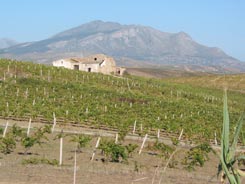
 A New Breed of Winemakers Is Shaking Up Sicily from TASTES OF ITALIA Magazine (July 2003) Renato De Bartoli is abstractly watching a Sicilian shepherd trespass on his vineyard. But the winemaker is not focused on the flock of sheep that's delicately nibbling at the foot of his Grillo vines, the starting point for some of Sicily's most esteemed Marsala. The only one who seems to care is De Bartoli's cinnamon-colored hound dog, who keeps anxiously looking over at his master between ineffectual barks. Instead, De Bartoli is gazing at the future in his mind's eye. "This will be our new cantina," says the young enologist, waving towards a deep hole in the earth next to the sun-drenched vines. His vision doesn't stop with expanded quarters and refurbished buildings, however. It incorporates something much grander - the recovery of marsala's reputation as a highly regarded meditation wine. Once prized by the world, marsala fell to shameful depths after being bastardized this century by mass-produced concoctions that included egg, almond, coffee, or other additives. Renato's father, Marco De Bartoli, set out to change all that when he stopped working for the large marsala houses and took over his family's property, a centuries-old source of grapes for marsala, founding his eponymous winery in 1976. He has doggedly taken the high road ever since, emphasizing quality over quantity. The result is a portfolio of wines whose praises are sung by critics far and wide. The next - and more difficult - step is convincing consumers to give misunderstood marsala another chance and not think of it just as flavoring for zabaglione. But one sip of De Bartoli's 30-year-old Vecchio Samperi should do the trick: an opulent amber hue, it's bone dry with aromas of dried fruit, nuts, spice, and caramel. I can easily imagine this accompanied by a plate of cheese in front of a roaring fire after dinner. If this is what Sicily's future holds, it looks pretty good. Sicilian wine is undergoing dramatic change, and De Bartoli is just one of many driving engines. For eons Sicily had been synonymous with bulk wine. Churning out 213 million gallons per year, Sicily produces more wine than any other region in Italy. Indeed, it's even more than all of Australia. Most of it used to be shipped north to provide added flavor and alcoholic heft to French and northern Italian wines. But recently Sicily has started coming into its own. Estate bottlings are on the rise. Major wine companies like Mezzacorona from Trentino and Zonin from Veneto are investing in land. Native Sicilians are leaving jobs with gargantuan wine firms to create their own boutique wineries, true labors of love. Despite the fact that wine has been produced in Sicily for 26 centuries - ever since the Greeks dropped anchor there around 650 B.C. - today Sicily feels like a veritable wine frontier, full of change and promise and growth. To get of picture of Sicilian wine in this moment of transition, I headed to Sicily's wild west - in the opposite direction of typical tourist destinations like Mt. Aetna, Syracuse, Taormina, and Cefalu. Travelers do have plenty to see in the west. There are amazingly intact Greek temples at Segesta and Selinunte; picturesque saline , where sea salt is made using an ancient system of diked ponds, windmills, and evaporation; and lively fish markets and opulent baroque architecture in the seaport town of Marsala. But the magnet that draws me and my husband is the concentration of wineries in the west, scattered around Marsala and Alcamo. Our first stop is Marsala, a city on the western tip of Sicily where the history of Italy's most ancient DOC wine begins. Although the origins of marsala wine date back to antiquity, its international fame began when the Liverpool merchant John Woodhouse blew into shore during a storm in 1773. This was during England's prolonged war with Spain, which meant that an embargo had deprived the British of their beloved sherry. Woodhouse thought marsala might make good substitute, so he loaded 70 barrels onto his ship, fortified it with alcohol for the long journey north, then waited for word from home. The response was so enthusiastic that Woodhouse opened a marsala firm on the spot. This was followed by another British enterprise in 1812, Ingham Whitaker & Co., then by the first Italian firm in 1833, founded by local son Vincenzo Florio. By mid-century, marsala had become Italy's most famous wine and gained a position of status alongside port, sherry, and madiera. Today Florio and its leading competitor, Pellegrino, are industrial-sized operations - producing 3 million and 5 million bottles respectively. We head to Florio, located in a huge enclosed complex on the edge of town, for one of their daily public tours and, we hope, a taste of their highly regarded Vecchioflorio Riserva. Our group - a busload of Germans and a smattering of Italians - is led around by a bored guide who rattles off marsala's history and production methods in a rapid monotone, cigarette dangling. "It's always the same man," mutters the perturbed German tour guide. His presentation is equally perfunctory in the tasting room, where, without comment, he pours samples of dry and sweet marsala into tiny plastic cups that look like Nyquil dispensers. We happily to escape to De Bartoli, a 75-acre property located seven miles outside of town, where real wine glasses are the norm, the owner's son is our gregarious guide, and production is limited to a mere 100,000 bottles per year. Renato De Bartoli shepherds us through a tasting of their portfolio, beginning with Grappoli del Grillo, a pleasant white table wine made from the same grape as marsala. (Grillo is just one of many obscure grape varieties found in Sicily. Along with tongue-twisters like catarratto, inzolia, gibellina, frappato, and the ubiquitous nero d'avola, these and other indigenous grapes offer a field day for adventurous wine lovers.) In addition to pouring two excellent Marsala Superiore, plus the top-of-the-line Vecchio Samperi, an unfortified sipping wine made using the sherry-style solera system of continuous blending, Renato offers a sample of their Moscato Passito di Pantelleria, named Bukkuram. I've been smitten with the moscato grape ever since my first poolside flute of Moscato d'Asti, the light frizzante version made in Piedmont. I've long considered this fragrant grape ‹ redolent of orange blossoms, apricots, and honey ‹ to be the nectar of the gods. It seems I'm in good company. Legend has it that Apollo himself was successfully wooed by the goddess of love, Tanit, when she substituted moscato from the volcanic island of Pantelleria for his daily ambrosia. Unlike Piedmont's fizzy version, the passito moscato from this tiny isle off the southwestern coast of Sicily is a still wine made from sun-dried moscato (here called zibibbo) grapes. Severe winds from the Sahara whip across the rocky terrain, stunting the growth of its low vines and marvelously concentrating the grapes' sugars and flavors. Another outstanding example of this dessert wine, with delectable hints of raisins and dates, is Ben Ryč Passito di Pantelleria by Donnafugata,. A successful marriage of old family and new technology, Donnafugata has its headquarters directly across the street from Florio in a cluster of buildings that appeared as a setting in Giuseppe Tomasi di Lampedusa's elegiac novel The Leopard. Their vineyards near the town of Contessa Entellina are also historically noteworthy. It's here that Queen Maria Carolina of Bourbon fled from Naples in the 19th century after the victory of the Napoleonic troops under Murat ‹ thus the name donna fugata, or fugitive lady. Donnafugata's affable marketing director, Marta Gaspari, recounts these stories as she leads us past towering fermentation tanks and through multiple aging rooms painted with fanciful designs. Overhead are poster-sized photographs hanging at regular intervals that show Donnafugata's various properties, which amount to 425 vineyard acres. We see grape harvesters hunched over knee-high zibibbo vines in Pantelleria. Next are shots of the famous night harvest done on the Contessa Entellina property. Begun six years ago, this experiment was initiated in order to save both men and grapes from the brutal sun. In August, temperatures easily reach a scorching 95 degrees. Under such conditions, microfermentation can take place in the hundred or so yards between cutting the grapes and hauling them into the cellar. Night temperatures, in contrast, are an ideal 60-65 degrees. By harvesting under artificial light, there's no microfermentation, nor is there thermal stress from rapidly cooling hot grapes down to 43-46 degrees during the refrigeration phase. What's more, it's ecologically sound, saving 75 percent on energy costs from reduced refrigeration needs. Further on, we see pictures of Donnafugata's beaming owners, Giacomo and Gabriella Rallo, and their extended family. This dynasty was once among the leading Marsala producers, but sold off that operation along with the Rallo brand name and reinvented themselves as Donnafugata in 1983. Their risks have paid off. Today Donnafugata's 15 wines are earning top prizes, particularly the Chardonnay Chiarandá del Merlo, full of tropical fruit and vanilla; the Milleunanotte ("a thousand and one nights"), a succulent nero d'avola; and Tancredi, a blend of nero d'avola and cabernet sauvignon. With the kind of success they're enjoying, it's no wonder the Rallos are smiling in every photo. If there's one winery that epitomizes the explosive growth of Sicilian wine right now, it's Planeta. Since its founding in the mid-nineties by three young and energetic cousins, Alessio, Francesca, and Santi Planeta, this winery has rocketed to the top, thanks to a combination of skillful winemaking and savvy marketing. At professional tastings, their table always attracts a buzzing crowd, and Planeta's smartly packaged wines have snagged precious shelf space in wine shops around the U.S., representing serious Sicilian wines alongside longtime behemoths like Corvo and Regaleali. What first attracted attention were its international varieties - chardonnay, merlot, and cabernet - but in recent years, Planeta's native offerings have been turning heads. Its inexpensive Segreta blends - based on nero d'dvola for the red and the Greek-originated grecanico for its refreshing white - are surefire winners, and its pure nero d'avola, called Santa Cecelia, is a bright, luscious wine full of cherry, black fruit, and toasted oak, which is deservedly racking up awards. The drive to Planeta's Ulmo vineyard takes us over arid mountains into a gorgeous valley near the sleepy town of Sambuca. Guided by vague directions and tiny signs, we continue down miles of gravel road to the estate, passing prickly-pear cactuses and the ruins of an Arab castle, and inching right through the middle of a sheep herd. We find Alessio Planeta busy in the fermentation room, huddled with a cluster of workers sampling the tanks to assess the recent harvest, so we spend some time walking around the premises. Outside acres of vines stretch to Lago Arancio, a reservoir named for the orange groves that once blanketed the area. The landscape here is stunning, fully expressive of Sicily's rugged beauty, with its rocky hills outlined against an ethereal blue sky. We walk to the main compound housed in a baglio, or fortified farmhouse - so characteristic of Sicilian rural architecture from past centuries - and spot some new construction underway: additional rooms for an agriturismo, a farm-based B&B.; Signs of growth are also evident in the tasting room. Planeta's newest baby is Cerasuolo di Vittoria, a DOC blend of frappato and nero d'avola grapes grown in the southern province of Ragusa. The frappato gives a distinctive strawberry-cherry character to this light red wine, prompting visions of poultry with dried fruit sauce as an enticing match. Planeta's Cerasuolo is as good an argument as any for getting over one's fear of the unknown when browsing a wine shop. If Planeta is Sicily's blazing comet, Alessendro di Camporeale and Azienda Agricola Ceuso might well be its rising stars. Both are new wineries near Alcamo started by teams of siblings who labored for years as agronomists and enologists for the provincial government or large companies, and now are fulfilling a life's dream with their own boutique vineyards. "How did you find me?" asks the slightly astonished Antonino Alessandro after we sit down in his office. In fact, it wasn't easy. A tip from De Bartoli sent us to the dusty hilltown of Camporeale, and the old men in the piazza pointed us to the courtyard where he lives - along with at least four other families bearing the same name. After we finally hit the right buzzer, Alessandro welcomes us in, then leads us to his unmarked vineyard 15 minutes outside of town. There the veteran enologist and his two brothers and partners, Rosolino and Natale, show us around their new property. From the small storage room he grabs a bottle of syrah that sports a handsome black label with an arabic motif and the name Kaid, in homage to the profound influence the Arabs had on Sicily over the centuries. "Americans may not like that," he says with a wry smile. But they'll certainly love what's in the bottle. Settling down in an informal tasting room that seems more like a family den, we taste the 2000 vintage - their very first bottling. "The 2000 keeps getting better," says Rosolino with an approving nod. Indeed, this syrah is an intense wine, full of spice, berries, and layers of persistent flavor. We're smitten, but Stateside purchases will have to wait until Alessandro finds a U.S. importer. Given what's in my glass, it shouldn't take long. Like Alessandro, the Azienda Agricola Ceuso is a tiny estate of about 85 acres started by three brothers - Antonino, Giuseppe, and Vincenzo Melia - who had careers as a farmer, enologist, and agronomist respectively before opening shop in 1990. Their Alcamo-area winery is still a work in progress, housed in a weather-beaten old baglio that's slowly being renovated. "Next year, we expect to have a tasting room there and some offices," says Vincenzo, an elegant grey-haired man, pointing to an upper floor where cooing pigeons huddle under the eaves. He leads us to the storage room for a tasting, with stacked cardboard cartons serving as makeshift tables. But there's nothing makeshift about the wines. The Ceuso Vigna Custera is a happy marriage between native and international grapes - nero d'avola, cabernet sauvignon, and merlot - characterized by cassis and raspberry layered with notes of leather. In 2002 Ceuso released a second IGT red called Fastaia, which is an unusual combination of nero d'avola, cabernet franc, and merlot - an equally compelling and complex wine. Signs of change are everywhere in Sicily, from De Bartoli's challenge to the marsala industry, to the experiments at Donnafugata, to the marketing savvy of Planeta, to the rising number of family-run wineries like Ceuso, Alessandro, as well as Spadafora, Cusumano, and many more. It all bodes well for Sicily - and for the wine consumer. Not only are there are more excellent labels to choose from, but the best is to still come; the newly planted vines have yet to fully mature and bear their best fruit. Meanwhile, prices on Sicilian wines remain very reasonable, with many landing on "Best Buy" lists. All this means there's no better time to explore Sicily's rich bounty and reap the benefit of its dramatic makeover. Patricia Thomson is a regular contributor to TASTES OF ITALIA and is president of La Dolce Vita Wine Tours. © 2003 Patricia Thomson |